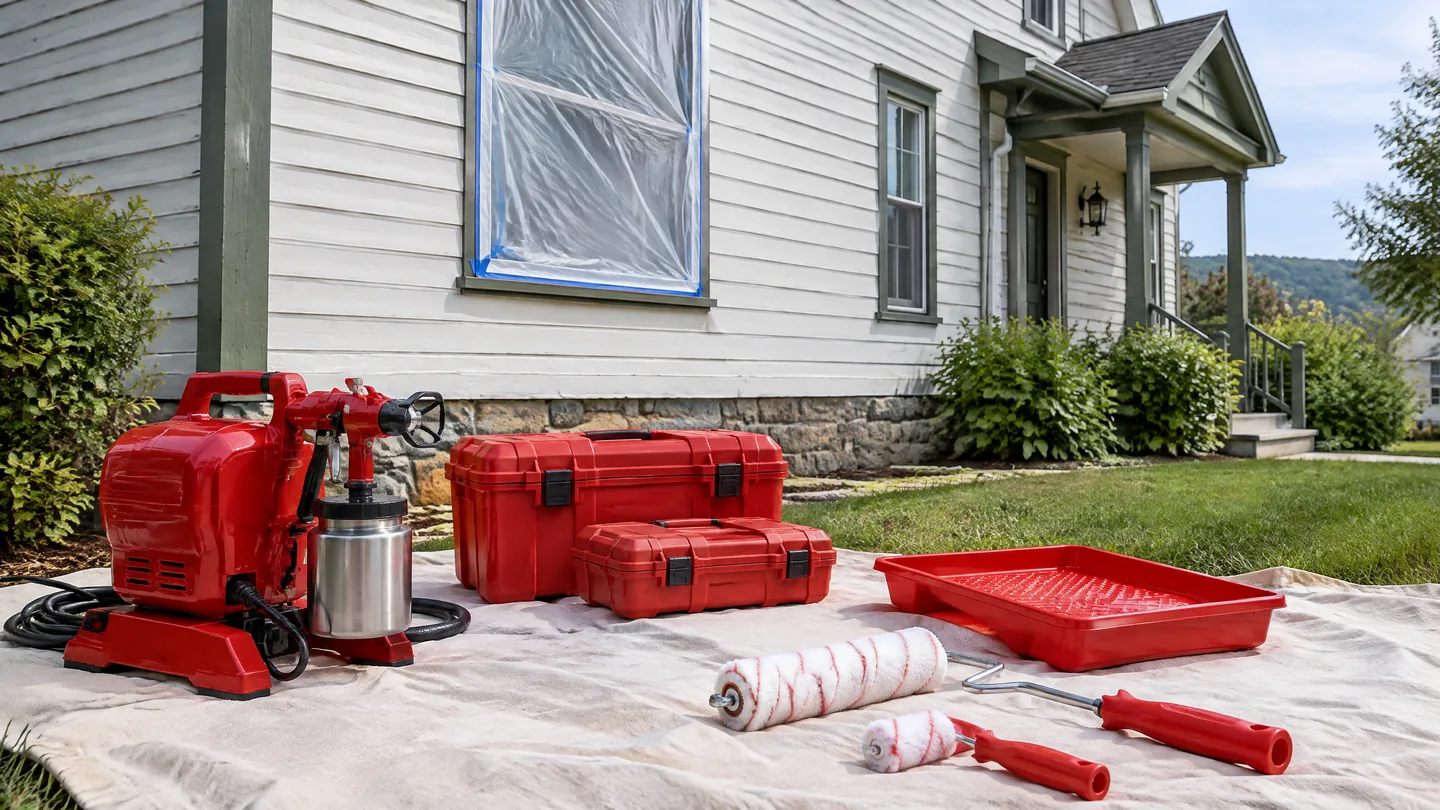
For an older Montrose home, identify lead risk and repair water entry before paint preparation. Confirm Borough review for the specific address and scope, use an appropriately qualified professional for hazardous or lead-affected work, and apply the chosen coating only on a dry, properly prepared surface under its own label conditions.
Start with the house, the scope and local review
Before a scraper comes out, walk the exterior on a dry day. Note peeling areas, soft trim, open joints, stains, gutter overflow, roof-wall intersections and repeat failure spots. Photograph and mark elevations. This makes a repair plan rather than a short-lived cover-up.
For a Montrose property, confirm the project scope with the Borough before committing to repairs or exterior changes. Susquehanna County’s official profile says Montrose Borough has building-permit and zoning requirements, as well as planning and floodplain ordinances. Ask the Borough whether the specific address, repair scope and any exterior alteration need permit, zoning, or historic-review confirmation. Do not assume a paint-only exemption or that a property is or is not subject to historic review. [1]
Treat pre-1978 paint as a lead decision
Federal restrictions ended residential lead-paint sales in 1978, but age does not prove that every surface contains lead. An older painted exterior deserves a lead-risk decision before sanding, scraping, demolition or window work. EPA advises a certified lead inspector or risk assessor for affected surfaces; if the year is unknown, its DIY guidance says the safer assumption is that lead may be present. [2] [4]
The paid-work boundary matters. EPA’s Renovation, Repair and Painting rule generally requires a firm and people performing paid paint-disturbing work in pre-1978 housing or child-occupied facilities to meet RRP certification and lead-safe practice requirements. Painting preparation is covered. Limited exceptions are scope-specific; exterior minor repair and maintenance must disturb no more than 20 square feet, while window replacement, demolition and prohibited practices are covered regardless of area. [3]
This guide does not claim that P&M Property Services LLC is RRP-certified. For a paid pre-1978 scope that is covered, ask any firm you are considering, including P&M, whether the project requires EPA RRP firm and renovator credentials and verify the answer before work begins. A homeowner working on their own owner-occupied home is generally outside RRP, but rentals, home child-care settings and profit-motivated flips are different. [2]
Solve moisture before coating
Peeling, blistering and repeat failure often begin with water, not paint brand. Purdue Extension identifies moisture as the most common cause of premature paint failure on wood. Rain and dew, bad flashing, roof runoff, gutters, ice dams, plumbing leaks, wet basements, attic condensation and indoor humidity can feed that problem. [5]
Follow the water path before authorizing prep. Repair failed flashing and roof defects, keep gutters and downspouts moving water away, address open joints or damaged siding, and investigate stains near kitchens, baths, laundry areas and gable ends. Replace decayed wood and correct active leaks before primer. Paint is not a structural or moisture repair. [5]
Use controlled preparation, not aggressive dry dust
Once the substrate is dry and sound, remove loose coating, dirt and failed caulk while preserving sound paint. On a suspected lead surface, an appropriate professional should plan containment before disturbance, keep occupants and pets out of the work zone, control chips and dust, and clean before containment comes down. EPA identifies misting before scraping or sanding, heavy plastic, HEPA vacuuming and wet cleaning as ways to control lead dust. [4]
Wet scraping and containment are not a casual shortcut for broad, elevated or lead-affected work. Leave extensive loose-paint removal, power sanding, ladder or scaffold work, exterior electrical hazards, decayed structural trim, and spring-loaded window components to an appropriate professional. The goal is a stable, clean surface and controlled waste, not simply a smoother-looking wall. [4]
For limited low-risk homeowner planning, document defects, move outdoor furniture away, protect landscaping as directed, and choose colors. Do not assume a dust mask, shop vacuum or drop cloth alone provides a lead-safe system. EPA recommends a lead-safe certified contractor for RRP projects in pre-1978 homes. [4]
Prime, caulk and follow the coating system
After repair and controlled preparation, clean and dry the surface, feather transitions between sound paint and bare areas, and use a primer compatible with the substrate and topcoat. Prime bare wood and repairs rather than expecting finish paint to repair adhesion. Caulk stable, appropriately sized gaps after substrate preparation with a paintable product suited to the joint. Avoid caulking drainage paths or moving joints that need a different repair.
Weather is part of the specification. Read the exact product label and technical data sheet for preparation, compatible primers, temperature range, dry time, recoat window and rain/dew limitations. Sherwin-Williams notes that exterior coatings need conditions in the suggested range and above the dew point during cure; requirements vary by product. Do not rely on a made-up calendar date or universal temperature rule. [6]
Homeowner checklist before exterior painting
Use this short list to make the estimate and preparation conversation more useful.
- Record the construction year, occupancy type and any known lead test or inspection results.
- Photograph each elevation, peeling zone, water stain, damaged board, window and gutter issue.
- Confirm whether roof, flashing, gutter, siding, trim, caulk, masonry or ventilation repairs come before paint.
- Ask Montrose Borough whether your address and scope require permit, zoning or historic-review confirmation. [1]
- For paid work that will disturb pre-1978 paint, discuss RRP applicability and verify required EPA credentials before scheduling. [2] [3]
- Select products only after the substrate and repair plan are known, then follow the specific manufacturer label. [6]
- Check service coverage for the exact address before relying on a painting appointment.
Mistakes that shorten paint life
Costly mistakes include painting over an active leak, treating every peel as a paint problem, using dry dust-producing methods on an older house, skipping containment, priming damp wood, and ignoring night dew and cure conditions. Do not assume local review never applies. Good preparation puts repair, safety, surface work and coating application in the right order. [4] [5] [6]
Getting help for a Montrose address
P&M Property Services LLC provides painting from Scranton and typically works within approximately 50 miles, but exact service coverage must be checked at the property address. Call +1 570-780-8074 to discuss the exterior, building age, moisture repairs and preparation scope. For a covered paid pre-1978 project, certification must be confirmed rather than assumed. [2] [3]
STRAIGHT ANSWERS
Common questions
Can I repaint an older Montrose house if I do not know whether it has lead paint?
Determine the construction year and consider professional testing. If the home predates 1978 or its age is unknown, plan as though lead may be present until an appropriate qualified assessment says otherwise. Do not begin dust-producing preparation while that decision is unresolved. [2] [4]
Does exterior paint always need a permit in Montrose Borough?
Do not make that assumption. Susquehanna County lists building-permit and zoning requirements for Montrose Borough, but the needed review depends on the address and exact scope. Ask the Borough whether repairs, exterior changes or a historic-review issue applies before work begins. [1]
Why did the previous exterior paint peel even though the new paint was high quality?
A high-quality coating cannot solve an active moisture path or overcome poor preparation. Rain, roof runoff, flashing failures, condensation, leaks, damp wood and inadequate cleaning can all lead to early failure. Diagnose and repair the cause, then prepare and coat a dry substrate under the product’s label conditions. [5] [6]
CHECK THE ORIGINAL GUIDANCE
Sources & local resources
Municipal rules, collection programs, and product instructions can change. Confirm current details before the work begins.
- Montrose BoroughSusquehanna County, Pennsylvania
- Lead Renovation, Repair and Painting ProgramU.S. Environmental Protection Agency
- Renovation, Repair and Painting Program: ContractorsU.S. Environmental Protection Agency
- Lead-Safe Renovations for DIYersU.S. Environmental Protection Agency
- Paint Failure Problems and Their CurePurdue Extension / USDA Forest Products Laboratory
- Exterior: Product Application Frequently Asked QuestionsSherwin-Williams
This guide explains preparation and general maintenance. It is not an engineering assessment, permit determination, or substitute for the equipment manufacturer’s instructions. P&M’s ability to help with a specific task is confirmed during the estimate.