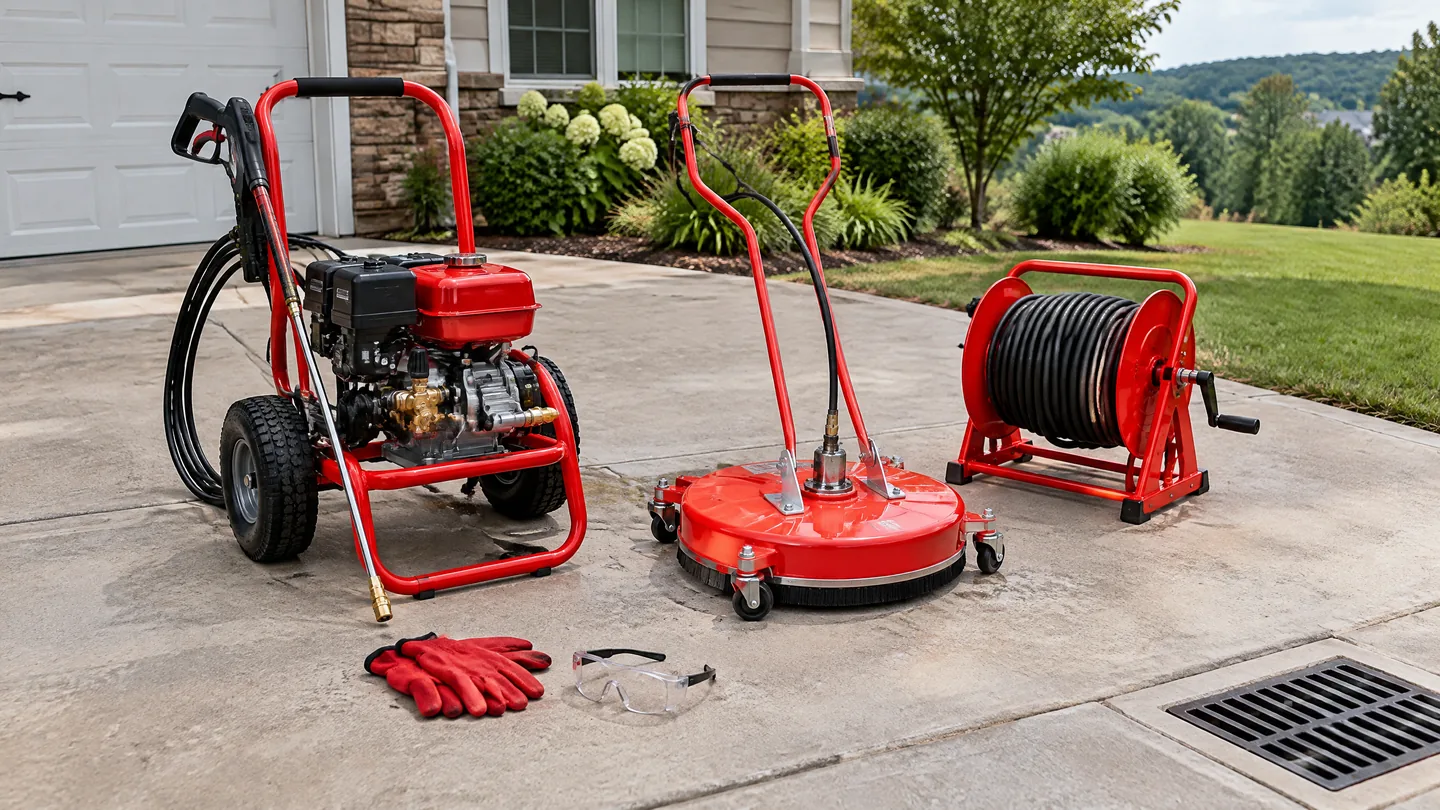
Inspect the driveway, verify cure and product guidance for new or repaired concrete, clear debris, protect every route to a drain or waterway, and test the least aggressive practical setting in an inconspicuous spot. Never send chemical cleaner or contaminated wash water into a storm drain or septic system. Confirm whether a Tunkhannock address is in the Borough or Township before seeking local guidance. [1] [2]
Start with the driveway, not the washer
A successful driveway cleaning starts with a condition check. In dry daylight, note cracks, loose or scaling concrete, exposed aggregate, spalled edges, old patches, flaking sealer, painted markings, and oil-stained areas. Photograph existing damage.
Ask when the driveway, repair, overlay, coating, or sealer was installed and identify the product if possible. Concrete products are commonly evaluated at a 28-day strength benchmark; QUIKRETE lists 28-day strength values. That is not universal permission to wash a new surface. Follow the pour contractor's and the exact product manufacturer's cure and cleaning guidance. Defer high-pressure work when the surface is new, chalky, delaminating, or uncertain. [6]
Clear debris and map where water will go
Sweep first. Remove leaves, gravel, pet waste, mulch, trash, and dry soil before water is introduced. Then trace the driveway slope toward the gutter, curb, catch basin, swale, ditch, and any creek path. Runoff from pavement can carry chemicals, dirt, and sediment to streams, lakes, and groundwater, so EPA emphasizes preventing pollution at its source. [3]
Keep debris and wash water away from every inlet and waterway. Use only a drain-protection approach that will not create a flooding or traffic hazard, and collect solids for disposal instead of pushing them downhill. Do not discharge chemical cleaner, oily wash water, or debris-laden water into a storm drain, roadside inlet, ditch, stream, or septic system. When oil, unknown residue, or drainage makes containment uncertain, stop and arrange appropriate professional handling. [3]
Confirm Borough or Township before asking about permits or drainage
A Tunkhannock mailing address does not identify the municipality. Check the actual property address first. For Tunkhannock Borough properties, the Borough lists its office and Borough Manager at 570-836-1548, Department of Public Works at 570-836-6166, and Zoning at 570-996-5538. These are the appropriate starting points for property-specific questions involving permits, a sidewalk or curb, public drainage, or a possible right-of-way issue. [1]
For Tunkhannock Township properties, contact the Township Office at 570-836-3934, 113 Tunkhannock Twp Dr, Tunkhannock, PA 18657. Do not assume that driveway washing is permitted, prohibited, or exempt; ask the applicable municipality when the plan affects drainage, a public facility, or another regulated feature. For general Pennsylvania MS4 permit-compliance questions, DEP lists the Bureau of Clean Water at RA-EPPAMS4@pa.gov and 717-787-5017. [2] [4]
Test low and increase only as the surface allows
There is no universal PSI for every driveway. Concrete age, mix, finish, sealer, repairs, nozzle, water flow, staining, and distance all change the result. Pick a small hidden area away from drainage, start with the least aggressive practical setting, use a broad fan pattern and controlled distance, then inspect after the surface drains.
Increase cleaning action only in small steps if the test remains sound. Keep the nozzle moving. Avoid concentrating the stream on cracks, joints, edges, patches, exposed aggregate, and lifting coatings. Stop if paste, sand, coating, or aggregate releases, or if the finish becomes rough or striped. Manufacturer instructions for the washer, nozzle, cleaner, and surface treatment override generic PSI charts.
Set up for eye, electrical, slip, and bystander safety
Read the washer instructions and inspect the hose, gun, cord, fittings, and tip. Use eye protection and task-appropriate footwear, hearing protection, gloves, and clothing. CDC-hosted guidance calls for PPE for the eyes, hands, feet, ears, and torso; it also says to ground the washer, test the GFCI, and keep cords out of streaming or standing water. [5]
Keep the wand away from people, pets, glass, vehicles, and electrical equipment. Keep bystanders out of the work area, manage trip hazards, and stop when footing is slick. Never operate a gasoline-powered washer in an enclosed area. Do not work from a ladder or elevated platform; the CDC-hosted guidance recommends a telescoping wand instead. [5]
Homeowner checklist before cleaning day
Complete these practical steps before a DIY session or before a service crew arrives. They help protect the surface and the drainage system.
- Identify concrete, patch, overlay, coating, or sealer, and gather installer or product guidance.
- Photograph cracks, spalls, loose material, stains, and coating failure.
- Sweep dry debris and move vehicles and portable items from the work zone.
- Locate every downhill drain, curb inlet, ditch, swale, waterway, and septic component.
- Use a hidden test area and begin with the least aggressive practical approach.
- Verify grounding and GFCI protection, and keep cords out of water. [5]
- Confirm Borough or Township jurisdiction before making a local permit or stormwater inquiry. [1] [2]
Mistakes that create damage or runoff problems
Avoid starting at maximum output, using a pinpoint stream on joints or repairs, or treating a coated driveway like bare concrete. Do not apply cleaner before resolving runoff. Chemicals, sediment, oil, and trash can become pollutants when runoff carries them from the driveway. [3]
Do not push loose debris toward the street, mix products, use products off-label, or pour leftover cleaner into a drain or septic system. A heavily oil-contaminated, deteriorated, steep, or water-adjacent driveway needs a deliberate runoff plan, not a last-minute fix.
Choose the sensible professional boundary
A sound, accessible driveway with no drainage conflict may be manageable for a person who can follow equipment and product instructions. Use a qualified pressure-washing professional when surface condition is uncertain, containment is required, staining involves oil or an unknown material, cleaning is near a drain or waterway, or recovery equipment is needed.
Use appropriate professional handling for heavy moves, elevated work, suspected lead-containing paint or coatings, electrical repair, or spring-loaded gates, doors, and mechanisms. P&M Property Services LLC provides residential and commercial pressure washing from Scranton, typically within approximately 50 miles; check exact service coverage for the property address. Call +1 570-780-8074 to discuss a site-specific scope.
STRAIGHT ANSWERS
Common questions
Do I need a permit to pressure wash my driveway in Tunkhannock?
Do not assume a yes or no answer. Confirm whether the property is in Tunkhannock Borough or Tunkhannock Township. Ask the appropriate office about the actual scope when drainage, a curb, sidewalk, public facility, or right-of-way may be affected. [1] [2]
What PSI should I use on concrete?
There is no universal PSI. Start in a hidden test area with the least aggressive practical configuration, a broad fan, and a controlled distance. Increase only if the surface remains sound, and stop if finish, patch, sealer, or aggregate releases.
Can driveway wash water go into a storm drain or septic system?
No. Do not direct chemical cleaner, oily wash water, or debris-laden water into a storm drain or septic system. Runoff from pavement can carry pollutants to water resources. Sweep first, control runoff at the source, and seek help when containment is unclear. [3]
CHECK THE ORIGINAL GUIDANCE
Sources & local resources
Municipal rules, collection programs, and product instructions can change. Confirm current details before the work begins.
- Contact UsTunkhannock Borough
- Tunkhannock TownshipTunkhannock Township
- Urbanization and Stormwater RunoffU.S. Environmental Protection Agency
- Municipal StormwaterPennsylvania Department of Environmental Protection
- Tip Sheet: Handling the PressureCDC STACKS / NIOSH archive
- Concrete Mix Selector GuideQUIKRETE
This guide explains preparation and general maintenance. It is not an engineering assessment, permit determination, or substitute for the equipment manufacturer’s instructions. P&M’s ability to help with a specific task is confirmed during the estimate.