Before snow arrives, map the driving and walking route, mark edges and drainage, choose snow-storage zones that preserve sightlines, and read deicer and equipment labels. Never put snow on a roadway. Confirm whether your address is in Dallas Borough or Dallas Township before relying on local rules; they are separate municipalities.
Plan the route before the first flake
Map the route people need: the vehicle path from garage or parking area to the street, the front-door walk, steps, ramps, trash access, and mailbox path. Walk it in daylight. Note tight turns, low curbs, landscape edging, slick shade, and door swings. Choose one primary pedestrian route rather than clearing a little everywhere.
Choose snow-storage zones before a storm. Keep piles away from driveway entrances and corners. For a driveway on a state road, PennDOT advises placing snow on the right side as you face the intersecting roadway, away from oncoming plows. Eliminate entrance piles where possible because they can obstruct driver sightlines. [3]
Stake edges and protect drainage
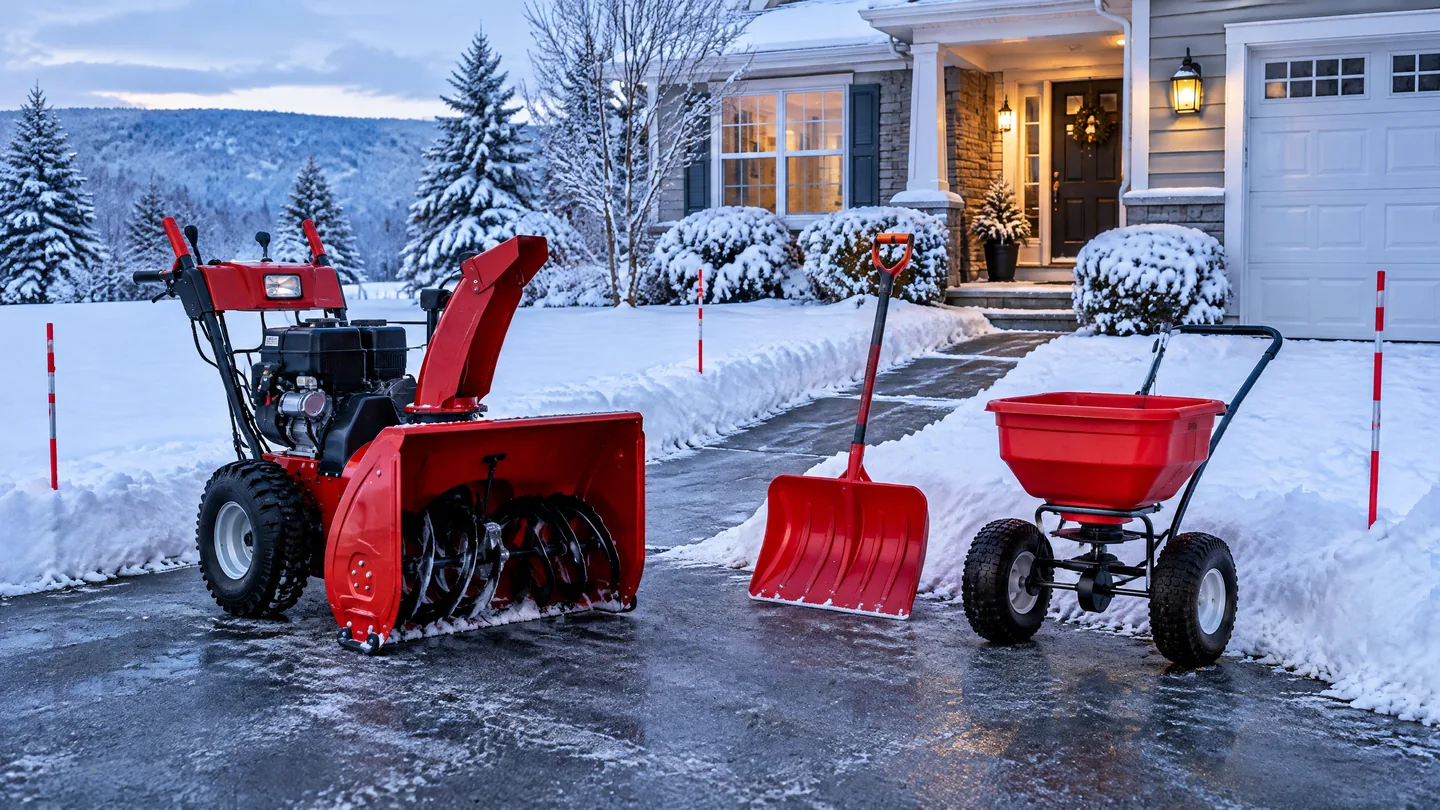
Mark driveway and walk edges, landscape borders, and features that disappear under snow with tall, flexible reflective stakes. Keep stakes outside tire and auger paths. Do not guess at a buried utility, damaged curb, or unclear boundary; pause and use qualified help for hazardous or uncertain work.
Identify gutters, swales, catch basins, downspout outlets, and the low point where meltwater leaves the drive. Keep a narrow path to those drainage features so meltwater does not refreeze across the route. PennDOT warns against obstructing highway drainage facilities, and Penn State Extension notes that melting snow can carry deicer into storm drains and waterways. [3] [4]
Plan for the plow windrow, not just the snowfall
A windrow is the compact ridge a road plow leaves at a driveway opening. Plan a final pass after the street is plowed. Clear the ridge back onto your property and keep the entrance low enough for people and drivers to see each other.
Do not push a windrow into the street, over a curb, or into a roadside ditch. PennDOT says not to shovel or plow snow from driveways or sidewalks onto a state road, and not to push snow onto roadways at any time. It says this creates a hazard and can expose a property owner to liability for resulting crashes. Near traffic, use lights and high-visibility gear. [3]
Use deicer labels as operating instructions
Shovel or sweep first. Deicer addresses the thin bonded layer that remains; it is not a substitute for moving deep snow. Read the bag for the surface, application rate, temperature range, storage, and safety directions. Apply only where feet or tires travel. Penn State Extension advises following the label, sweeping up excess for reuse, and storing deicer in a waterproof container. [4]
The active ingredient matters. Rock salt is sodium chloride; calcium chloride, magnesium chloride, and calcium magnesium acetate have different performance and environmental tradeoffs. Extension identifies CMA as a lower-impact option than chloride deicers, while noting that excessive use of any deicer can cause problems. Never use fertilizer as deicer, and keep loose granules out of drains and away from salt-sensitive plants. [4]
Snowblower, fire, and carbon-monoxide safety
Read the snowblower manual before the storm and inspect the machine only while it is off. Never run a fuel-powered snowblower in a garage, shed, or other enclosed space. CPSC warns that the exhaust contains poisonous, odorless, colorless carbon monoxide that can kill in minutes. Maintain working CO alarms on every home level and outside sleeping areas, and test them monthly. [5] [6]
Never reach into a clogged chute. CPSC says to stop the engine and use a long stick for wet snow or debris, not your hands. Keep children, pets, loose clothing, fuel, and ignition sources away from the operating area. Follow the manual for fueling and maintenance, and clear snow from exterior vents for fuel-burning appliances. [5] [6]
Keep portable heaters on a stable surface at least three feet from items that can burn. Plug them directly into a wall outlet, not a power strip, and never leave one unattended. [6]
Dallas Borough and Dallas Township are not interchangeable
A Dallas mailing address does not by itself identify the municipal jurisdiction. Dallas Borough and Dallas Township are separate local governments in Luzerne County; the Township Road Department lists snow plowing and stormwater maintenance among its work. [1] [2]
Before relying on a local notice, sidewalk obligation, parking rule, or road-removal instruction, confirm whether the property is in the Borough or Township and whether the adjoining road is state or locally maintained. No local clearance deadline is stated here because none was verified in the local sources reviewed. PennDOT’s no-snow-on-roadway guidance applies to state-road frontage. [3]
Dallas homeowner snow-prep checklist
Complete these steps before the forecast becomes urgent. They reduce the chance that snow is placed where it blocks drainage, visibility, or the road.
- Mark driveway and sidewalk edges, steps, curbs, drainage points, and obstacles.
- Choose snow-storage zones that preserve entrance sightlines and keep snow off every roadway.
- Leave a final-pass area on your property for the roadside windrow.
- Stage a shovel, broom, traction aid, deicer, gloves, lighting, and high-visibility outer layer.
- Read deicer and snowblower labels; keep deicer dry and use only the labelled amount.
- Test smoke and CO alarms, clear appliance vents from snow, and check the snowblower manual. [5] [6]
Decide what is sensible to do yourself
DIY is reasonable for a short, level route when you can work steadily, operate equipment safely, and keep snow on the property without blocking drainage or visibility. Stop when conditions are icy, visibility is poor, the area is steep, or the job exceeds your physical capacity.
Do not climb, lift beyond your ability, or improvise around heavy, elevated, electrical, fuel-system, spring-loaded, or potential lead hazards. Those tasks need appropriate professional handling. For a long, heavy, commercial, steep, or hard-to-access site, professional snow removal can be the safer boundary.
P&M Property Services LLC offers residential and commercial snow-removal service from Scranton, typically within approximately 50 miles of Scranton. Service coverage and availability must be confirmed for the specific address; call +15707808074.
STRAIGHT ANSWERS
Common questions
Can I push driveway snow into the street in Dallas, PA?
No. PennDOT says not to shovel or plow snow onto roadways at any time. For state-road frontage, place snow on the right side of the driveway as you face the intersecting roadway and keep entrance piles low enough to protect sightlines. [3]
Should I use more salt when the sidewalk stays icy?
Not automatically. Remove as much snow and ice as possible first, then follow the deicer label’s application instructions and use it only in travel areas. Sweep up excess rather than adding more. The active ingredient and temperature range on the label matter. [4]
How do I know whether Dallas Borough or Dallas Township rules apply?
Confirm the property’s municipal jurisdiction with the appropriate local government before relying on a notice or local rule. The Borough and Township are separate municipal governments, and a Dallas mailing address alone is not enough to assume which one governs the property. [1] [2]
CHECK THE ORIGINAL GUIDANCE
Sources & local resources
Municipal rules, collection programs, and product instructions can change. Confirm current details before the work begins.
- Dallas Borough official websiteDallas Borough
- Dallas Township official websiteDallas Township
- Winter PreparationPennsylvania Department of Transportation
- Watershed-friendly DeicingPenn State Extension
- Protect Your Family During Winter and COVID-19U.S. Consumer Product Safety Commission
- CPSC Issues Winter Weather Safety Tips to Prevent Fires and Carbon Monoxide PoisoningU.S. Consumer Product Safety Commission
This guide explains preparation and general maintenance. It is not an engineering assessment, permit determination, or substitute for the equipment manufacturer’s instructions. P&M’s ability to help with a specific task is confirmed during the estimate.